Wednesday, September 28, 2011

Men are Men, but Women are Girls

I first posted this at Girl Museum's blog.  Too nice a day to write two separate posts, and I fear that work must come before play.
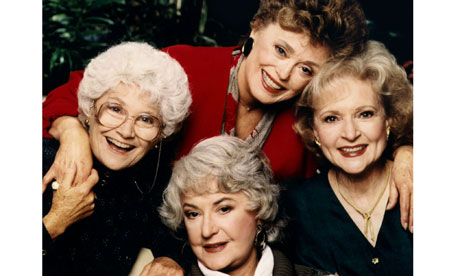

The Golden Girls. Photograph: Allstar/Cinetext/

Language is a funny thing.  Words often carry connotations and subtle meanings we don't think about on a daily basis, but can greatly affect our language choices and how we interpret things.  These subtle clues and changes in definition may prompt you to think "that's why we have thesauruses" (thesaurusi?), but sometimes the societal overlays cannot be captured strictly by a thesaurus.

Take the word "woman" for example.  Woman, as defined by a dictionary--the one built into my computer's operating system, in this case--means "an adult human female."  Simple and to the point, no?  It does go on to expand the definition in a variety of ways (employment, role, duties, etc.), but in it's essence, a woman is an adult human female.

On the other hand, "girl" has two definitions.  First is "a female child."  Second is where our potential confusion enters: "a young or relatively young woman."

What's wrong with "woman?"  Or "young woman?"  Well, I can't speak for everyone, but connotations have been formed, and, according to Carolyn Bronstein, the author of Battling Pornography: The American Feminist Anti-Pornography Movement, 1976-1986, "Girls are young and sexual and pretty and focused on their bodies and focused on attracting people of the opposite sex. A girl doesn't have to take things so seriously."  On the other hand, Bronstein adds, "Woman carries the image of an older, strident, militant kind of feminist presence that is, in popular culture today, frowned upon."  In short: "Woman just weighs heavily, and girl is light."  Additionally, every time I've heard the phrase "young woman" used, it's generally condescending.

Hollywood has certainly picked up on this trend.  There were the Designing Women, but mostly we've seen the girls of Sex and the City.  Once upon a time there were Two Guys, a Girl, and a Pizza Place (eventually losing the pizza place); the mother-daughter duo of the Gilmore Girls; Gossip Girl is still talking about Manhattan's elite; and reality show The Bad Girls Club is still running.  And who can forget about The Golden Girls?  Those four feisty women showed that, at least once upon a time, being over the age of 50 and widowed or divorced was not all bad.  This fall, all those girls will be joined by New Girl, 2 Broke Girls, and on HBO, plain ol' Girls.

Now, I haven't seen these shows, and all I know about them is what I've read (which honestly, isn't much).  But before I saw anything about these shows beyond their titles, I could have told you that they are all about women in their twenties, who are attractive, and primarily in-and-out of relationships (with equally attractive twentysomething men).  Why?  Because they are about "girls," "not women."  And apparently, women aren't fun-loving, attractive, or interesting.

To be fair, I don't know how accurate my interpretation is, but since "friends" isn't a practical name for a sitcom, something else had to be used.  So why girl?  Because it's marketable.  Most females in the demographics that networks are aiming for seem to refer to themselves as girls (or are at least assumed to).  I know I'm guilty of that, and I know I'm not alone.  I don't inherently see anything wrong with choosing to be labeled a girl over a woman, but I am sad that the word "woman" seems to carry a stigma.

"Men" and "man" don't face the same issues, though "boy" can range from mildly insulting to extremely offensive, depending on the circumstances.  But men are lucky.  They not only can be "manly" or "a man's man," but they can also be a "guy" or "one of the guys."  Women don't have such a luxury, or a surfeit of terms.  As "Grammar Girl" Mignon Fogarty says, "It would be nice to have a female equivalent of 'guy,' [...] I suppose it would be 'gal,' but that sounds quite antiquated."

Thursday, September 22, 2011

Because it is Thursday

Because it is Thursday, and Mom and Barbara go out on Thursdays (and apparently talk about my blog from time to time, which makes me think that hobbies need to be found--not that I don't appreciate the readership, because I do), I need to post something.  I have a whole bunch of posts stored in my head for the food blog--though I'm forgetting how to make the curried carrot soup, so perhaps that's one post less--but I'm rather lacking in worthwhile content here on this lil ol' blog.

Depending on your perspective, there's either nothing to report or lots to report.  Three weeks from tomorrow we'll be in Nottingham for the weekend, at what might possibly be the coolest beer festival ever. We went last year for the first time, and it was awesome to max, and we're meeting up with friends from Leicester again this year (same friends, even.  Perhaps our only friends.).  This year, however, we're more prepared.  Not only are we going for two nights--because you can't sample 900+ ales and ciders in only one night--but this time we're going prepared.  Camping chairs for the festival, since seats and tables are not provided, Tylenol/paracetamol for the head, multi-vitamins to prevent the crushing weakness brought on by alcohol purging all vitamins and minerals from the body, and "magic juice" which apparently prevents vomiting.  Water nearly made The Boy hork--in Sainsbury's, no less, while I was trying to find a sandwich--but Copella Apple Juice made him semi-human again.  I'm also insisting upon some V-8, which has a different set of nutrients in it.  We'll even bring some food to supplement the pork pies and other food at the festival, though we're planning on eating at Olde Trip (under the Castle, where the festival is) and I'd like to try the pub that's across from the entrance to the Castle grounds, which I believe is a Castle Rock Brewery pub.

Eight weeks from Sunday we'll be on a plane to the states.  Eight weeks from Saturday we'll be on a train to the super-posh Radisson-Blu hotel in Manchester airport, because I didn't think about trains when I booked our flights.  My logic was "hey, it's the same price to fly Sunday as it is to fly Monday, so we get an extra day for free!"  Except trains don't start running on Sundays much before 9am, and our flight leaves Manchester at 9am, so that doesn't really work.  Oops.  But still, a nice way to ease us into our holiday.  And no faffing about with cabs or hotel shuttles, because there's literally an entrance to the hotel *in* the airport.  Badass, that is.  Also, we've stayed their before, and the fear of bedbugs or getting raped/robbed is minimal.  In our advancing years, The Boy and I seem to be afraid of new hotels, especially if they're cheap.

Beyond our future travels, I've applied for a few jobs, made about 2 gallons of soup in varying flavors (broccoli cheddar, curried carrot, parsnip Parmesan, and chicken and dumplings), randomly made a half-batch of chocolate chip cookies last night (note: a half batch makes way faster than a full batch, but far fewer than half the amount of cookies.  I did eat a bunch of dough, and saved some for The Boy, so that may account for part of the problem).  I have a weird variant of writer's block, in that I know where and what and how, but I need the words to get them there (trans: I hate and suck at writing prophecy.  I also hate the notion of prophecy, which is not lessening my problems.).

I also bought this:

I named it Roger.

For reference purposes, the white bit is nearly as long as my arm, and I can't actually wrap my hand around it and have my fingers touch.

Wednesday, September 7, 2011

On Storytelling

In case you somehow missed it, I love to read.  I love stories.  I love the way a good author can craft a tale in a way that will draw me in and compel me to continue reading, either because the quest is interesting (usually not, actually, if you want to closely examine pretty much any story), or more likely because of the impact the journey has on the protagonist.  The best stories are about characters and how they react to events and grow throughout the quest.  Essentially, everything else is a MacGuffin.  Now I'm not saying that the quest/journey/plot isn't interesting and important, because it is, but it's how it affects the character that is most interesting.  A well-crafted mystery can achieve both; you want to know how and why _____ happened, and there should be some sort of impact on the characters.  A less-well crafted mystery will have you less interested in the characters, but still curious about the how and why (pulp fiction is a good example--hard-boiled dicks are all basically the same, but the mystery might still be good).  And conversely, a mystery that's purely character driven can be a bit dull as well; you did want a mystery to puzzle over, didn't you?  Even so, if only half of a mystery novel is well-crafted, then it's still a fun read.

A prime example of a rather crappy plot but a character that grows is actually the rather trashy Anita Blake series.  The plots are all really quite similar, and fairly forgettable, but the characters grow over time.  Anita, especially, but all the characters exhibit change in relation to their surroundings and events.  Terry Pratchett's Discworld novels are interesting in the fact that the world itself is effectively a character.  It grows and changes in response to the characters who populate it, and it's one of the few constants throughout his novels--yes, Death appears in every Discworld novel, and the Night Watch, Witches, Lord Ventinari, and others appear regularly, but the true star of the novels is the world itself.  I don't like some of the plots or their main characters (Thief of Time), but I love the effect that the characters have on the world; Going Postal, for example, introduced a mail system, and The Colour of Magic introduced the concept of insurance (and the idea of burning down your building for money).  These ideas grow throughout the novels they're introduced in, as well as subsequent novels.  Pratchett's world is anything but static, and it's the most fascinating part of his novels.

But still, it all comes down to characters.  And that, my friends, is why I think the medium of TV is wonderfully suited for storytelling.  Mom and Dad don't watch a lot of TV, unless you count baseball in the summer and football in the fall/winter, but they do tend to watch shows on USA Network.  Conveniently, USA's slogan is "Characters Welcome."  And if you look at every single show they put out, they are character driven.  Monk.  Yes, there are weekly mysteries, and many of them were excellent (and a few were crap, but for 8 seasons, there was probably less than a full season total of bad, or even mediocre episodes).  But the real reason to watch Monk was to watch Adrian Monk cope--or not--with the loss of Trudy, with the loss of his badge, and with his crippling OCD and 312 different phobias.  Monk could have been designed as a novel or series of novels (and there are spin-off novels), but to truly bring Monk to life, to be successful in making him believable, Monk needed Tony Shaloub.  Tony Shaloub managed to make Monk human.  Seriously flawed, and with comedic touches, but human.  Monk is believable as a human being.  I think the real humanity would be hard to portray in a novel.  The expressions that flash across his face, and the struggle he goes through to touch or try to not touch things would be far too wordy in a novel, but necessary to humanize him.  Without them, Monk is a caricature; but with them, in written form, the reader will be continuously yanked out of the story by the details of Monk's compulsions.  With an actor behind the OCD and the phobias, however, Monk was praised by people who suffer from excessive OCD as being real, as being an example of what they actually suffer through, while still being funny at times, but not mocking or hurtful.

USA has done something else with their characters now.  I didn't think about it this way until Mom said it, but on Suits, they've created a character who I viewed as the lead (even though he gets second billing), but Mom views as the MacGuffin.  Mike is someone we actually care about, someone who reacts to, and grows and changes in response to external stimuli.  But I think Mom is right; Mike's job is to act as a MacGuffin for Harvey.  Now, I think you could argue that many characters serve as MacGuffin's for many other characters: in Burn Notice, the burn notice itself is a MacGuffin, but this season so was Max--or at least his death.  In literature, Lord Voldemort is far more MacGuffin than character.  In the Harry Potter books, he rarely ever acts as a character, even when he's there (and mostly he's not--he's discussed and feared, but rarely do we see him in person).  He is the reason for the quest.  He also happens to be a character, and not even a completely one-dimensional one, but mostly, he's the MacGuffin.

But why do I think TV is such a great medium for storytelling?  Well, in a good, scripted TV show (not "reality," which is also scripted, and certainly not real, but isn't designed to tell a story), you have the same necessary elements as you have for a book.  You're writing a story, so you need the same things.  You need a plot/journey/quest/raison d'ĂȘtre, you need a protagonist and usually some other characters, and you need the characters to emotionally grow and change in response to the quest that's been put upon them (theoretically, this is optional, but trust me, it's not).  But once you put the words into the mouths of actors, you get something else--real depth of humanity.  People you really care about.

I care about Anita Blake, and I care about Harry Potter, but Monk was real to me.  Alicia on The Good Wife is absolutely real to me.  She would be an excellent character in a novel, but Julianna Margulies adds life to Alicia, by being able to show all those little things that can be hard to put into words.  Conversely, it can be hard to translate some things to screen--the depth and richness of Tolkien's world is one, though Peter Jackson did a credible job overall, and I have no notion how you could reasonably translate the magic of Cooper's King of Shadows to the screen.  But where TV has, at least in my mind, the advantage over movies, is that it's serialized.  It's broken down into chapters.  We may satisfactorily wrap up one week, and another week we may be left with a cliffhanger (Lost, it got old after a time).  But you always know there's more.  In a movie, theoretically, that's it.  In reality, there will probably be at least one sequel, and probably more, but it's supposed to be done, finis.  Like a novel, you may want to visit it again, but TV, like a novel, keeps you driving forward because there's always a next chapter.  Until there's not, but networks have started to not do that to fans as often now, in part to avoid another "Nuts" incident, I would bet.  TV is an extended novel, one that has convenient stopping points, but another chapter if you want there to be.  And if not, you can stop at any point.

Sunday, September 4, 2011

Reading List: August 2011

AUGUST

50.  The Lightning Thief, by Rick Riordan (Percy Jacksom & The Olympians #1)
49.  The Lunatic Cafe, by Laurell K. Hamilton (Anita Blake, Vampire Hunter #4)
48.  Myth Conceptions, by Robert Asprin (The Myth Series #2)
47.  Another Fine Myth, by Robert Asprin (The Myth Series #1)
46.  Resident Evil: Zero Hour, by S. D. Perry (Resident Evil Novelizations #0 (7))
45.  Abraham Lincoln, Vampire Hunter, by Seth Grahame-Smith

JULY

44.  Circle of Flight, by John Marsden (The Ellie Chronicles #3)
43.  Incurable, by John Marsden (The Ellie Chronicles #2)
42.  While I Live, by John Marsden (The Ellie Chronicles #1) (sequel series to The Tomorrow Series)
41.  *Anne's House of Dreams, by L.M. Montgomery (Anne of Green Gables Series #5) (I'm making the same assumption as below)
40.  *Anne of Windy Poplars, by L.M. Montgomery (Anne of Green Gables Series #4) (I'm assuming I've read this before; I don't remember it, but the corners of some pages are creased as markers.)
39.  Circus of the Damned, by Laurell K. Hamilton (Anita Blake, Vampire Hunter #3)
38.  The Laughing Corpse, by Laurell K. Hamilton (Anita Blake, Vampire Hunter #2)

JUNE

37.  Guilty Pleasures, by Laurell K. Hamilton (Anita Blake, Vampire Hunter #1)
36.  *Harry Potter and the Prisoner of Azkaban (Harry Potter #3)
35.  *Harry Potter and the Chamber of Secrets (Harry Potter #2)
34.  *Harry Potter and the Philosopher's Stone (Harry Potter #1)
33.  Ptolemy's Gate, by Jonathan Stroud (The Bartimaeus Trilogy Book 3)
32.  The Golem's Eye, by Jonathan Stroud (The Bartimaeus Trilogy Book 2)
31.  *The Amulet of Samarkand, by Jonathan Stroud (The Bartimaeus Trilogy Book 1)

MAY

30.  Pride and Prejudice and Zombies, by Jane Austen and Seth Grahame-Smith (I've read Pride and Prejudice before, but sans zombies)
29.  I Am Number Four, by Pittacus Lore (pseudonym for James Frey and Jobie Hughes) (Lorien Legacies #1)
28.  *Anne of the Island, by L.M. Montgomery (Anne of Green Gables Series #3)
27.  *Anne of Avonlea, by L.M. Montgomery (Anne of Green Gables Series #2)
26.  *Anne of Green Gables, by L.M. Montgomery (Anne of Green Gables Series #1)
25.  The Red Queen, by Philippa Gregory (Cousins' War #2) 
24.  The Girl Who Kicked the Hornets' Nests, by Stieg Larsson (Millennium Trilogy #3)

APRIL

23.  The Girl Who Played with Fire, by Stieg Larsson (Millennium Trilogy #2)
22.  Disappearing Ingenue Stories, by Melissa Pritchard
21.  The Girl with the Dragon Tattoo, by Stieg Larsson (Millennium Trilogy #1)
20.  Resident Evil: Code: Veronica, by S. D. Perry (Resident Evil Novelizations #6)

MARCH

19.  Resident Evil: Nemesis, by S. D. Perry (Resident Evil Novelizations #5)
18.  Resident Evil: Underworld, by S. D. Perry (Resident Evil Novelizations #4)
17.  Resident Evil: City of the Dead, by S. D. Perry (Resident Evil Novelizations #3)
16.  Resident Evil: Caliban Cove, by S. D. Perry (Resident Evil Novelizations #2)
15.  Resident Evil: The Umbrella Conspiracy, by S. D. Perry (Resident Evil Novelizations #1)
14.  Nation, by Terry Pratchett (NOT a Discworld novel)

FEBRUARY

13.  *King of Shadows, by Susan Cooper
12.  Zombie Apocalypse!, created by Stephen Jones (compiled)
11.  The White Queen, by Philippa Gregory (Cousins' War #1)

JANUARY

10. * Mrs. Pollifax and the Golden Triangle, by Dorothy Gilman (Mrs. Pollifax Series #8)
 9.  The Other Side of Dawn, by John Marsden (The Tomorrow Series #7)
 8.  The Night is for Hunting, by John Marsden (The Tomorrow Series #6)
 7.  Burning for Revenge, by John Marsden (The Tomorrow Series #5)
 6.  Darkness, be My Friend, by John Marsden (The Tomorrow Series #4)
 5.  The Third Day, The Frost (aka The Killing Frost), by John Marsden (The Tomorrow Series #3)
 4.  The Dead of Night, by John Marsden (The Tomorrow Series #2)
 3.  Skin Trade, by Laurell K. Hamilton (Anita Blake, Vampire Hunter #17)
 2.  *Harry Potter and the Deathly Hallows, by J. K. Rowling (Harry Potter #7)
 1.  Tomorrow, When the War Began, by John Marsden (The Tomorrow Series #1)